



The last 20 meters in automation have long been a bottleneck: Sensors and actuators had to be wired individually – the more safety signals and diagnostic data needed to be transmitted, the more complex the wiring became. EUCHNER solves this problem with IO-Link Safety, and instead of many wires, only a single cable is needed to transmit everything. And it goes even further: more functions, more data, more than just a safety signal.
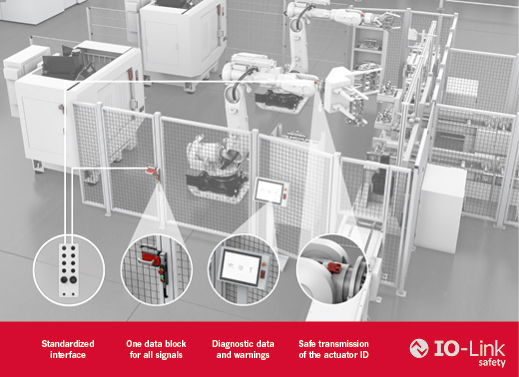
With IO-Link Safety, EUCHNER significantly simplifies communication over the last 20 meters. Instead of transmitting information via many individual wires, only a single cable is now used as a plug-and-play solution. The result: no more individual wiring. This is particularly practical for safety locking devices on machines, where many individual wires converge. Furthermore, traditional concepts provided little more than a digital signal – safe or unsafe, yes or no, safety door open or closed.
One cable, more to it
The answer is IO-Link Safety. An extension of the proven IO-Link protocol that transmits safety and additional data together via a single point-to-point connection to an IO-Link Safety Master – up to SIL3 / PL e, standardized according to IEC 61131-2.
The decisive advance lies not in simplified wiring alone, but in a fundamental leap in functionality: Instead of merely signaling safe/unsafe, the devices provide context-related information. Which actuator triggered the signal? Why was a door opened? Is the door mechanism working properly? “With IO-Link Safety, we transmit safety information including context. This opens up functions that were previously not technically possible,” explains Xabier Antolin, Head of Product Management at EUCHNER.
This semantic level creates the basis for new machine concepts – and as a welcome bonus: comprehensive diagnostic data in real time.
Good reasons for IO-Link Safety
IO-Link Safety uses the same connection technology as standard IO-Link. The user simply needs an IO-Link Safety-compatible master. It provides a single standard for all devices, from simple sensors to complex safety locking devices. New features such as the safe transmission of actuator IDs, key data, or mechanical status provide information that was never available via traditional wiring. At the same time, planning and installation efforts are significantly reduced: a single cable replaces many individual wires. Device parameters can be quickly transmitted via IO-Link Safety, enabling fast device replacement without long downtimes. In addition, comprehensive status data and diagnostic logs are available in real time. The user not only sees that errors have been triggered, but also why – this reduces downtime and facilitates targeted maintenance.
Safe communication via standard cables – without additional effort
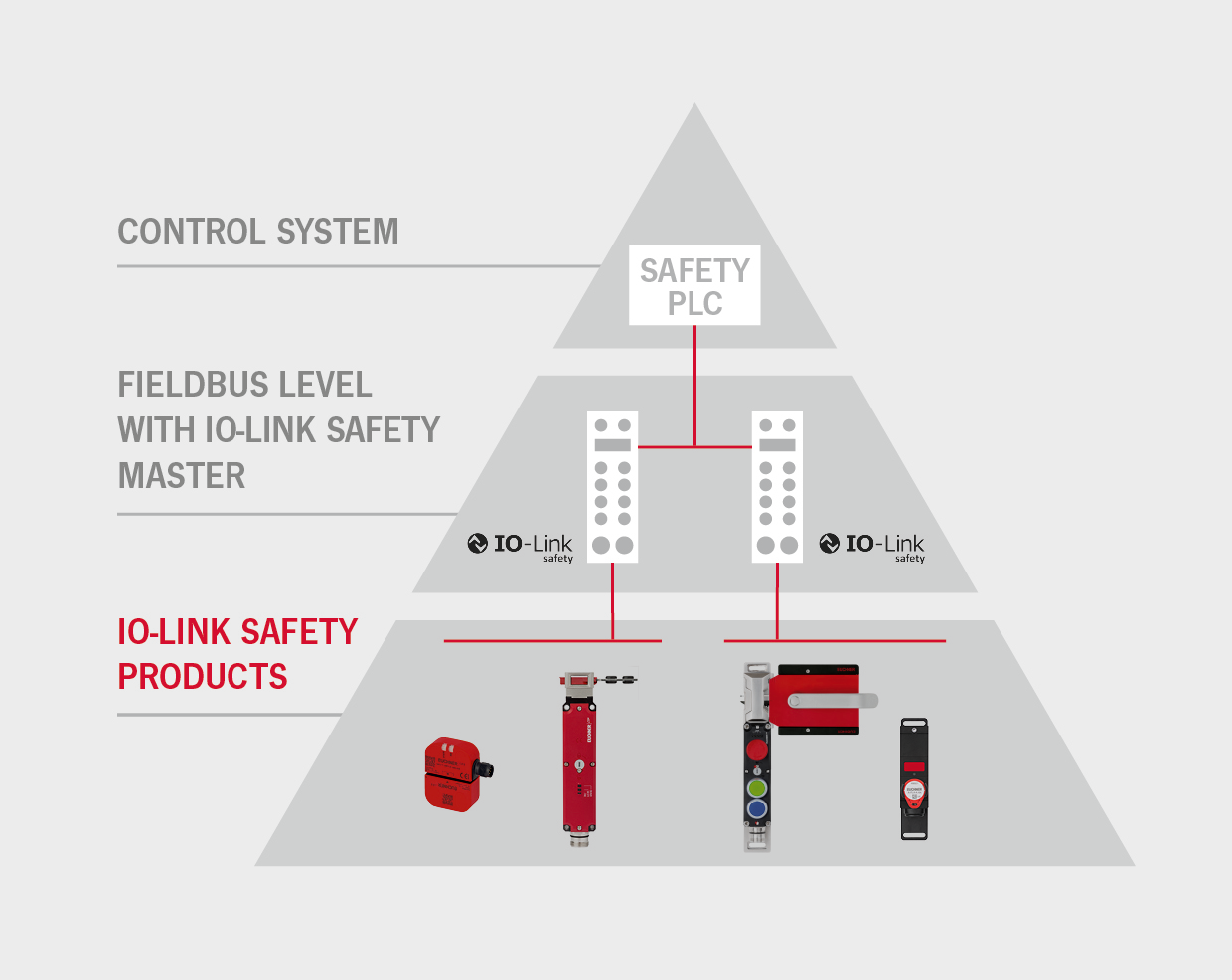
Technically, IO-Link Safety is based on the so-called black-channel approach: safety data is transmitted via a physically unsafe channel but is reliably protected. For the user, this means full safety without having to configure details themselves.
Compared to traditional safety bus systems, IO-Link Safety uses compact data structures and cyclic point-to-point connections. Response times remain low, and the system architecture is straightforward.
Two EUCHNER concepts coexist on the market:
- Safety switches from the BP/BR series in combination with a gateway (ESM-CB or GWY): Non-safe data is transmitted via IO-Link, while safety signals are wired conventionally – suitable for existing systems and extensions of existing topologies.
- Integrated IO-Link Safety: Safety and auxiliary data are transmitted together via IO-Link Safety to the master – the future-oriented solution for new machine concepts.
Why address this now?
Machines are becoming more flexible, variants more numerous, and integration density higher. Traditional wiring limits this development. IO-Link Safety extends the proven IO-Link protocol with a safe communication layer, paving the way for truly modular safety concepts.
Machine builders benefit immediately, especially in systems with frequent format changes, decentralized safety points, or high diagnostic requirements: in custom machine building, in flexible manufacturing cells, and in assembly technology. This is particularly true for small and medium-sized businesses: standardized, scalable safety technology ensures future-proofing without replacing existing fieldbus and control systems.
Know-How Meets Practice
EUCHNER has been developing and producing bus-based safety technology since 2008. IO-Link Safety now enables proven transponder-coded safety switches, safety locking devices, and guard locking systems to communicate safely up to SIL3 / PL e. The focus is not on the interface itself, which is standardized and manufacturer-independent. The difference lies in experience: EUCHNER’s safety experts know which information from safety components is critical – and extract it in a targeted way.
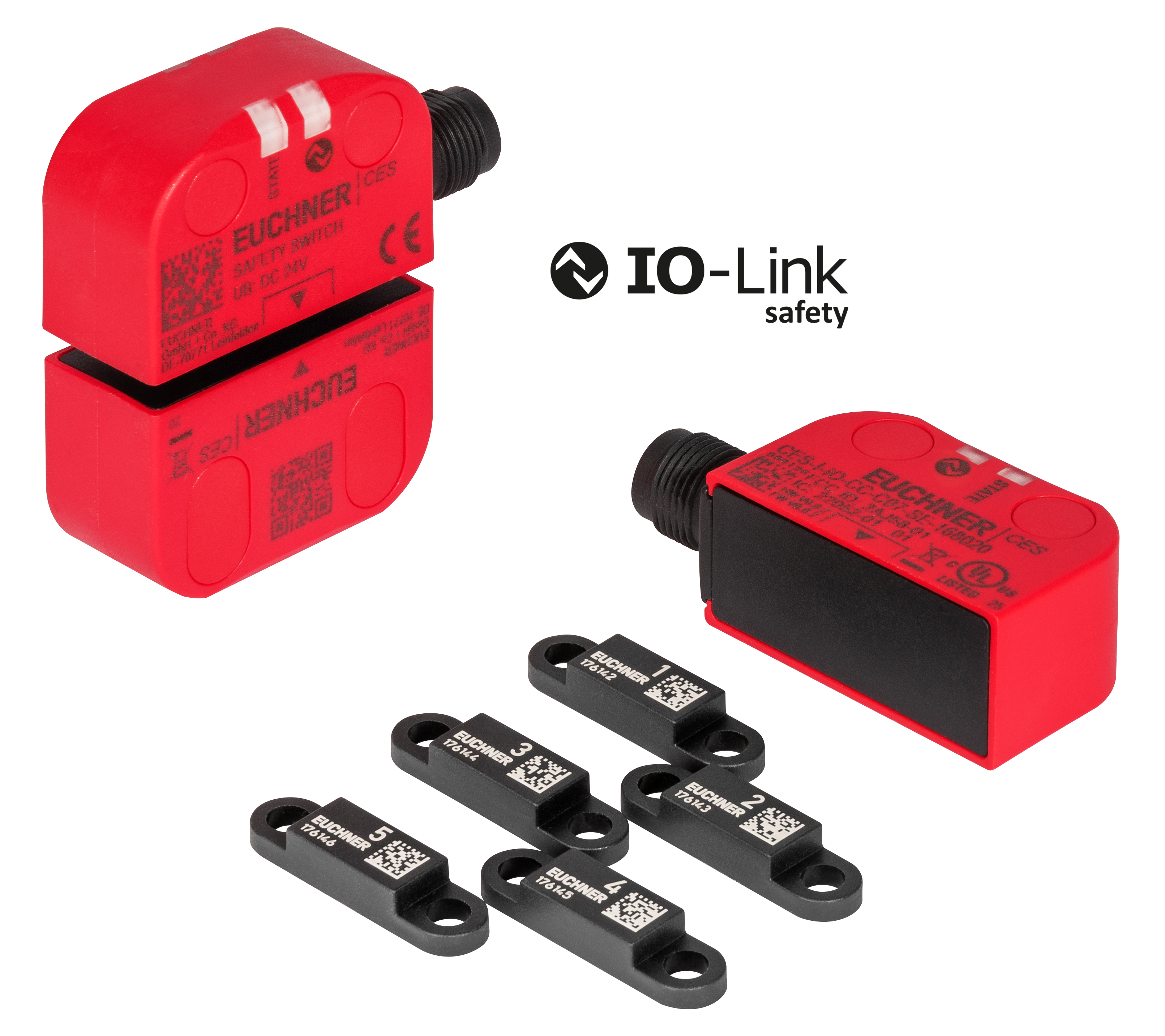
The first fully integrated product is the CES-C07: a compact safety switch without guard locking. urther devices, including CTP safety locking devices with IO-Link Safety, are in preparation..
“We don’t stop at simplifying the last 20 meters. We go further to ensure safe, context-rich communication across the entire safety chain,” emphasizes Xabier Antolin.